
Owners of older villas sometimes reach a point where the renovation scope feels so extensive that a full teardown and rebuild starts to seem like the simpler option — "if we're doing this much work, why not just start from scratch?" It's a reasonable question, and in a small number of genuinely extreme cases, the answer is yes. But when you compare the two paths on total cost of ownership — not just construction cost, but time, financing, disruption, and risk — renovation wins for the overwhelming majority of villas, including most that feel, at first glance, like they need to be rebuilt.
What "total cost of ownership" actually includes
A cost comparison that only looks at construction spend per square foot is incomplete. The full comparison needs to include demolition cost, the value of time (financing costs, lost rental income, or alternative accommodation costs during the build), authority approval timelines, and the risk premium of a ground-up project versus a defined renovation scope. Once these are added in, the gap between renovation and new-build widens considerably in renovation's favour.
| Factor | Full Renovation | Teardown & New Build |
|---|---|---|
| Typical timeline | 4-8 months | 18-24+ months |
| Demolition required | Selective (interior strip-out) | Full structure demolition |
| Foundation & structure | Retained (unless specific issue found) | Rebuilt from foundation up |
| Authority approval complexity | Moderate — renovation NOC | High — full new-build permitting |
| Cost relative to renovation | Baseline | Significantly higher, often 2-4x |
| Risk of unknowns | Moderate — site survey reduces surprises | Lower structural risk, higher budget/schedule risk |
| Disruption during works | Contained to the property | Extended, full-site construction period |
Why the structure is usually worth keeping
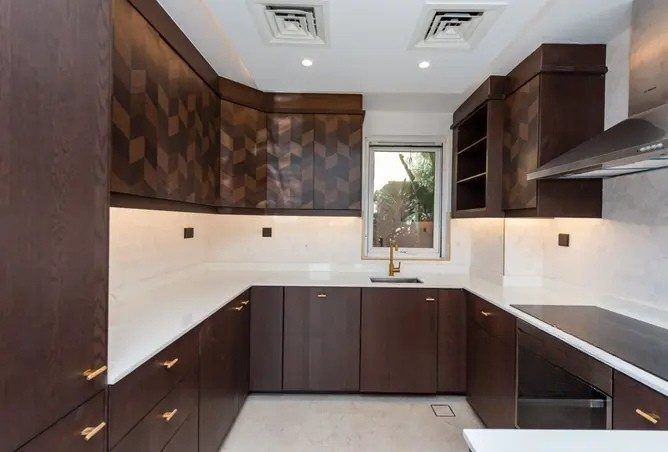
In Dubai's established villa communities, the concrete frame and foundation of a villa built in the early-to-mid 2000s are, in the vast majority of cases, structurally sound — what's dated is the finishes, the MEP systems, and sometimes the internal layout, none of which require demolishing the building to fix. A full renovation can replace flooring, walls, kitchens, bathrooms, electrical, plumbing, and even reconfigure internal layouts through selective structural modification — all of which our team executed on The Meadows villa project, including removing a load-bearing partition to create an open-plan kitchen and living space, without touching the foundation or frame.
Rebuilding from scratch means paying to demolish a structurally sound asset and rebuild an equivalent one — cost that adds nothing to the eventual outcome beyond what a well-scoped renovation already achieves.
⚠ New-build approval timelines are easy to underestimate
Beyond construction time itself, a new build requires fresh architectural approval, structural engineering sign-off, and full authority permitting essentially from zero — a process that can add months before any construction even begins. A renovation NOC process, while still requiring proper documentation and approval, is typically faster because the underlying structure and plot use are already established.
When a new build genuinely makes sense
There are legitimate cases where renovation isn't the right answer — a structure with serious, uneconomic structural damage, foundation issues that a survey confirms are beyond cost-effective repair, or a layout and orientation so fundamentally mismatched to the owner's needs that no renovation scope could reasonably resolve it. These situations are the exception, not the rule, and should be confirmed by a proper structural survey before ruling renovation out — not assumed from a first impression of a dated property.
If you're trying to work out which category your villa falls into, our guide on when a villa needs a full renovation versus a refresh covers the specific signs that separate "needs extensive work" from "needs to be rebuilt" — the two are very rarely the same thing.
The investment angle
For anyone evaluating this as an investment decision rather than a personal residence choice, the total-cost-of-ownership gap matters even more, because a new-build's longer timeline means a longer period of holding costs before any return is realised. Our guide to buy-renovate-sell investing covers how this factors into underwriting a value-add project properly.
Not sure if your villa needs a renovation or something more?
A site visit and structural assessment gives you a clear, honest answer before you commit to either path. Our Renovation Cost Calculator is a useful starting point for scoping a renovation budget.
Request a Site VisitFrequently asked questions
Is it cheaper to renovate a villa or build a new one in Dubai?
Renovating an existing villa is almost always cheaper and faster than demolishing and rebuilding, largely because you retain the existing structure, foundation, and — critically — the plot in an established, already-desirable community. A full villa renovation typically costs a fraction of a full teardown-and-rebuild project.
How much longer does a new-build take compared to a renovation?
A full villa renovation typically takes four to eight months. A teardown and new build involves demolition, fresh authority approvals, structural construction from foundation up, and full MEP installation — commonly stretching to 18-24 months or longer before the property is livable.
When does a new build make more sense than renovating in Dubai?
A new build can make sense when the existing structure has serious, uneconomic structural problems, or when the current layout and orientation are fundamentally incompatible with what the owner needs — situations where no renovation scope could reasonably resolve the underlying issue.