
Walk into most villas mid-renovation and you'll find the lighting plan reduced to a single decision: which chandelier goes over the dining table. It's understandable — a beautiful fixture photographs well. But a statement piece bolted onto a room with no plan behind it almost always disappoints, either glaring at full brightness or leaving the rest of the room in shadow. Good lighting design is a layering exercise, and the statement fixture is only the last layer applied on top. This matters more in Dubai than most places: with blackout curtains drawn against the heat for much of the year, artificial lighting isn't a supplement to daylight — for long stretches it is the light in the room.
The four-layer model
Lighting designers plan in four layers. The most common villa-renovation mistake is treating only one as the whole job:
- Ambient (general) lighting — the base level of illumination in a room, usually from recessed downlights, a ceiling cove, or indirect coving light. This gets you around the space safely; it isn't meant to do any visual heavy lifting on its own.
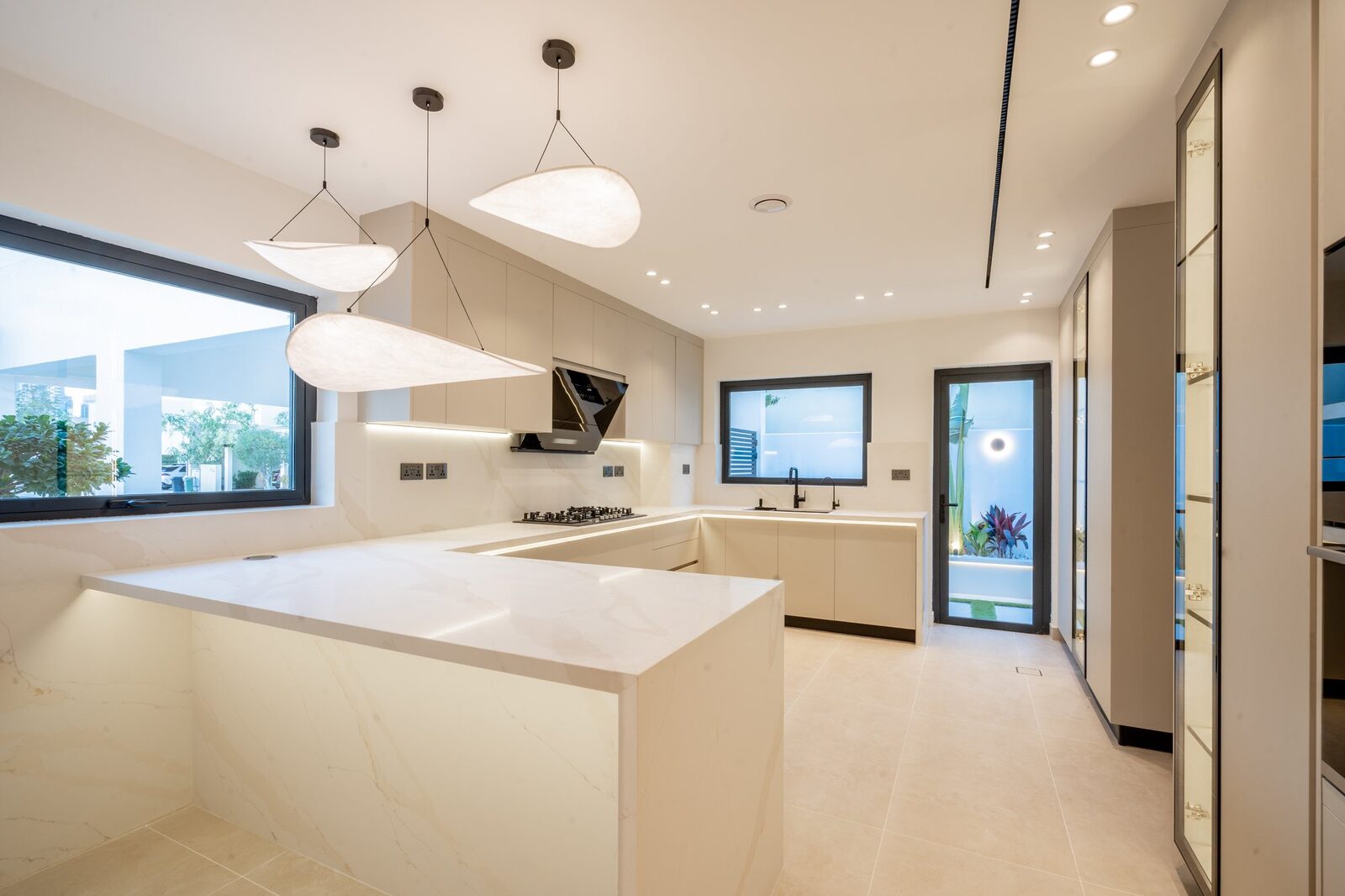
- Task lighting — focused light for a specific activity: under-cabinet strips in a kitchen, a reading lamp beside a sofa, vanity lighting either side of a bathroom mirror rather than only overhead.
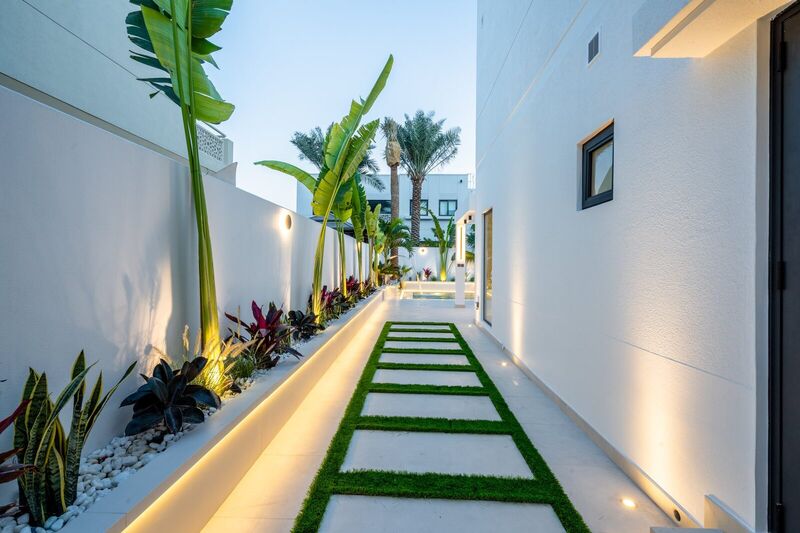
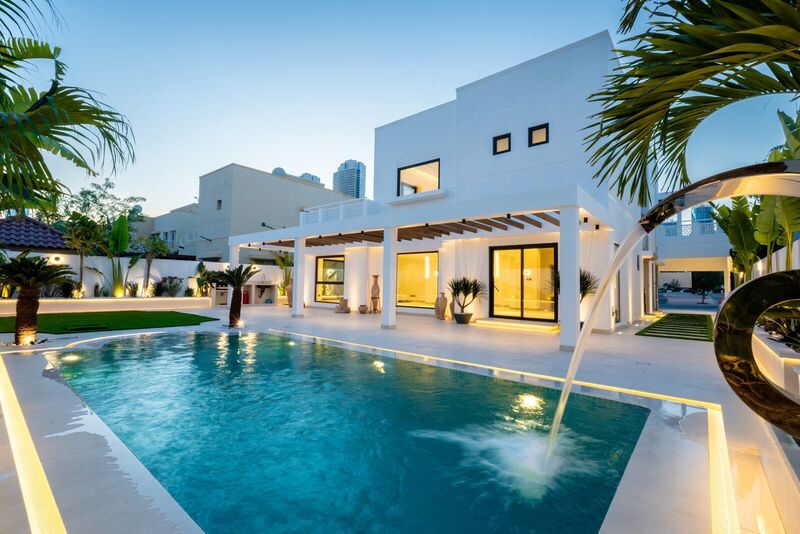
- Accent lighting — light used to draw the eye to something: a wall-washed piece of art, a niche, a textured feature wall, landscape lighting on a garden tree.
- Decorative or statement lighting — the fixture that is itself the visual object: a sculptural pendant, a chandelier, a cluster of hanging globes.
A single ceiling fixture tries to be all four layers at once and succeeds at none of them: it's rarely bright enough for genuine task use, it can't create shadow or depth as the only source in the room, and when it's switched off, the room goes fully dark rather than settling into a softer mood. Separate the four functions onto different circuits, and a room can shift from bright and functional by day to layered and atmospheric by evening — using the same fixtures, just different combinations switched on.

Colour temperature: get this wrong and nothing else matters
Colour temperature, measured in Kelvin, is the single most common lighting mistake we correct — usually because fixtures were bought on price without specifying it. The rule of thumb for a residential interior:
- 2700-3000K (warm white) for living rooms, bedrooms, and dining areas. This is the range that reads as genuinely residential — warm, flattering to skin tone, and close to the colour of candlelight or an incandescent bulb.
- 3500-4000K (neutral white) for kitchens and task-heavy zones, where slightly cooler light helps with colour accuracy while chopping, cooking, and reading labels.
- 5000K and above should generally be avoided entirely in a home. This is genuine "office" light — clinical, bluish, and the fastest way to make an otherwise beautifully finished room feel like a clinic waiting area rather than somewhere to relax.
Colour temperature also changes how every other finish in the room reads. A warm greige wall or a soft sage joinery colour can look muddy under cool light and rich under warm light — the exact interaction we cover in our guide to modern colour palettes for Dubai interiors. Choose paint and lighting separately, on different days, and this is where mismatches creep in.
CRI — the number nobody asks about but should
Colour Rendering Index (CRI) measures how accurately a light source reveals true colours, on a scale up to 100. Two bulbs can share the same Kelvin rating and still render colour completely differently if their CRI differs. For most living spaces, CRI 80+ is acceptable, but in two zones it's worth specifying CRI 90+ as standard: kitchens, where you're judging whether food actually looks fresh, and dressing areas, where you're judging skin tone and outfit colours before you leave the house. Cheap LED strips are the most common CRI offender — fine on a spec sheet, grey and lifeless in person.
Dimming and circuit planning — decide this before first fix
Every statement fixture and every accent layer needs its own dimmable circuit, decided at the electrical first-fix stage — while walls are open and cable runs can still be routed. Adding a dedicated dimmer circuit after plaster and paint are finished means chasing new channels through a completed wall: disruptive, costly, and often simply skipped, leaving a fixture stuck on a single switch shared with three other lights.
💡 Plan your circuits at first fix, not afterwards
Walk your electrician through every room before first fix and mark exactly which fixtures need their own dimmable circuit and where each switch plate should sit. Retrofitting a dedicated circuit after walls are closed up means chasing plaster to bury new cable — far more disruptive, and far more expensive, than specifying it correctly the first time.
This is also the point to decide whether individual dimmer circuits are enough, or whether you want scene-based control — one button that recalls "movie night" or "dinner party" lighting across several circuits at once. That level of control is usually delivered through a smart home integration layered on top of the dimming circuits, and it needs the same first-fix planning, since retrofitting it later is just as disruptive as adding a missed circuit.
Where a statement fixture actually earns its place
Not every room benefits from a showpiece fixture. The spaces where a genuine statement piece pays off share a common trait: height, volume, or a clear focal sightline it can occupy without competing with anything else.
- Double-height entrance foyers, where the vertical drop of a large fixture visually anchors the volume of space.
- Over a dining table, sized to roughly two-thirds the table's width — too narrow and it looks stranded, too wide and it overwhelms. Hang it so the base sits around 75-90cm above the tabletop, low enough to feel intimate without blocking sightlines.
- A primary staircase void, where a suspended piece can be appreciated from multiple floors as people move through the house.
Everywhere else — secondary bedrooms, hallways, powder rooms — restraint serves the room better than a competing showpiece. A house with five "statement" fixtures has no statement at all; it has visual noise. This is one of the recurring themes across broader interior design trends for Dubai villas this year — moving away from maximalist fixture choices in every room, toward one or two genuinely considered moments and quiet layering elsewhere.
Circadian and tunable-white systems
Circadian, or tunable-white, lighting is one of the few genuinely useful lighting technologies to arrive in recent years, rather than just another feature to sell. These systems shift colour temperature automatically through the day — cooler, brighter light in the morning to support alertness, gradually warming and dimming through the afternoon and evening. In a home office, this noticeably reduces the fatigue of working under one flat colour temperature for eight hours. In living areas, an evening-triggered warm-down reduces blue-light exposure before bed, without anyone switching anything manually. It's not worth specifying everywhere, but in rooms where people spend genuinely long, fixed hours — a home office, a primary bedroom — it earns its cost.
Circuits for tunable-white and circadian systems, like scene control, need planning at the same first-fix stage as everything else. Coordinating this alongside the wider electrical scope is exactly the kind of detail covered properly under a full MEP upgrade rather than left as an afterthought bolted onto a general villa renovation package.
Getting the scale right
A pendant that's the right shape but the wrong size is a common mistake, easy to avoid with two rules of thumb. For a single pendant over a table or in a room's centre, add the room's length and width in feet and use that number in inches as a rough fixture diameter — a 12ft by 14ft room suggests a fixture around 26 inches across. For hanging height above a dining table, allow roughly 75-90cm from tabletop to the base of the fixture. These are starting points, not formulas to follow blindly — but they catch the two most common scale mistakes: a pendant lost in a large room, and one that dominates a modest one.
Planning Your Lighting Scheme?
Get a realistic budget for your renovation, including electrical and lighting scope, in a few minutes.
Try the Cost CalculatorFrequently asked questions
What is layered lighting and why does it matter?
Layered lighting means combining several distinct sources — ambient, task, accent and decorative — instead of relying on one central ceiling fixture. It matters because a single source flattens a room and leaves it either glaring or gloomy, while layers let you dial each function up or down depending on the time of day and how the space is being used.
What is circadian lighting and is it worth installing?
Circadian, or tunable-white, lighting automatically shifts colour temperature through the day — cooler and brighter in the morning, warmer and dimmer in the evening — to support the body's natural rhythm. It's genuinely worth installing in home offices and main living areas where people spend long hours, since it reduces evening blue-light exposure without any manual switching.
How many light layers does a Dubai villa living room typically need?
A well-lit villa living room typically needs all four layers: ambient (recessed downlights or a cove), task (reading lamps near seating), accent (wall washers on art or joinery) and one decorative statement piece, each wired to its own dimmable circuit. That usually means four to six separate circuits rather than a single switch.